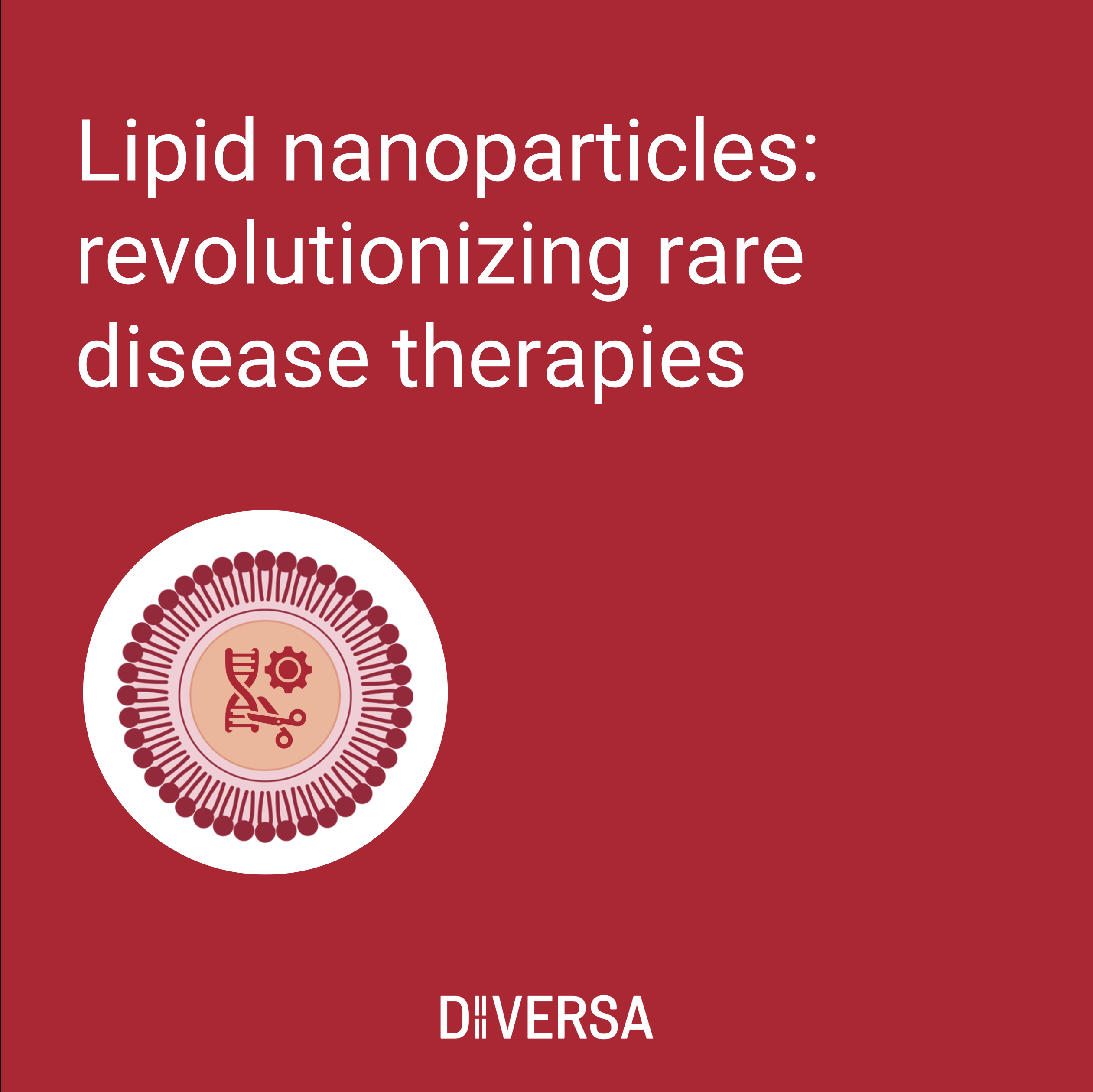
Lipid nanoparticles are transforming rare disease treatment by enabling targeted mRNA and gene therapies. Learn how nanomedicine drives personalized, point-of-care solutions.
The rare disease dilemma
More than 300 million people worldwide live with a rare disease. Most of them face a long diagnostic journey, limited treatment options, and, more often than not, no cure at all.
Developing therapies for rare and ultra-rare diseases has traditionally been slow, risky, and commercially unsustainable. The high cost of drug development, combined with small patient populations, makes traditional pharmaceutical models ineffective.
But that is changing. The rise of precision medicine, and especially nucleic acid-based therapeutics like mRNA, siRNA, and CRISPR, is opening a new chapter in rare disease care.
To make these therapies viable, one challenge must be overcome: how to deliver them safely, effectively, and personally. That is where lipid nanoparticles (LNPs) and non-viral delivery solutions are stepping in.
Why rare diseases need smart delivery systems?
Rare diseases are often genetic at their core. They may involve missing or defective proteins, overactive genes, or mutations that disrupt critical biological processes.
Nucleic acid-based drugs offer a unique solution:
- mRNA can encode functional proteins.
- siRNA can silence toxic gene expression.
- CRISPR systems can directly edit faulty genes.
However, these powerful therapies are fragile, charged, and difficult to deliver to the right cells without being degraded. The delivery platform determines whether they succeed or fail.
For rare disease patients, often children, often with multi-organ involvement, delivery systems must be:
- Highly targeted
- Flexible and modular
- Safe for repeated use
- Adaptable to small-scale or bedside production
Lipid nanoparticles: a precision medicine enabler
Lipid nanoparticles have proven their value in RNA delivery, most notably in COVID-19 mRNA vaccines. Now, this same technology is being reengineered for rare disease therapies.
What makes LNPs ideal?
- They encapsulate and protect fragile nucleic acids from degradation.
- They enable intracellular delivery by fusing with cell membranes.
- Their composition is modular: tunable for payload, tissue targeting, and immune response.
- They support rapid formulation and scaling, perfect for small, individualized batches.
For rare diseases, this means:
- Faster development cycles
- Personalized drug design
- On-demand production at or near the point of care
Real-world applications in rare disease
Several nucleic acid therapies for rare diseases have already reached clinical or regulatory milestones, many using NP-based platforms:
- mRNA therapies for methylmalonic acidemia and propionic acidemia, delivering enzymes the body cannot produce.
- siRNA for hereditary transthyretin amyloidosis, silencing the production of mutant proteins.
- CRISPR-Cas9 delivered via LNPs for conditions like sickle cell disease, offering one-time curative editing.
These approaches rely on the precision and safety of LNPs to target the liver, muscle, CNS, or even immune cells, beyond the limits of viral vectors.
DIVERSA’s innovation: biodegradable, ready-to-use nanoparticles
To truly serve the needs of rare disease patients, delivery systems must be as adaptable as the therapies themselves. At DIVERSA, we have engineered a new generation of LNPs to meet this challenge head-on.
What makes our formulations different?
- Biodegradable by design: ensuring safer metabolism and clearance.
- Stable at room temperature: simplifying logistics and enabling decentralized formulation.
- Plug-and-play compatibility: suitable for mRNA, siRNA, CRISPR, and future nucleic acid formats.
- Extrahepatic potential: designed to reach tissues beyond the liver, such as muscle, lung, or tumor sites.
- Magistral-friendly: optimized for on-demand, small-batch compounding in hospital or near-patient settings.
These innovations position DIVERSA’s nanoparticles the ideal platform for personalized RNA delivery, whether for clinical development, academic research, or point-of-care therapeutics.
We are not just building nanoparticles. We are building a delivery system for a new model of care.
Conclusion: making rare therapies possible, and personal
Lipid nanoparticles are no longer just carriers; they are catalysts of a new therapeutic model.
By enabling modular, scalable, and safe delivery of nucleic acid therapies, they are transforming the economics and logistics of treating rare diseases.
What was once impossible, a personalized therapy for a population of one, is now within reach.
And for patients and families affected by rare diseases, that makes all the difference.
Visit www.diversatechnologies.com or send an email to info@diversatechnologies.com to explore our solutions.
References
Internal References
- How Can Nanotechnology Boost Gene Therapy Potential in Rare Diseases?
- Personalized nanomedicine at the bedside: the next frontier in RNA-Nanoparticle Therapies
- How nanotechnology is shaping the future of personalized medicine
External References
- Tambuyzer, E., Vandendriessche, B., Austin, C. P., Brooks, P. J., Larsson, K., Miller Needleman, K. I., … & Prunotto, M. (2020). Therapies for rare diseases: therapeutic modalities, progress and challenges ahead. Nature Reviews Drug Discovery, 19(2), 93-111. https://doi.org/10.1038/s41573-019-0049-9
- Shen, G., Liu, J., Yang, H., Xie, N., & Yang, Y. (2024). mRNA therapies: Pioneering a new era in rare genetic disease treatment. Journal of Controlled Release, 369, 696-721. https://doi.org/10.1016/j.jconrel.2024.03.056.
- Kalland, M. E., Pose-Boirazian, T., Palomo, G. M., Naumann-Winter, F., Costa, E., Matusevicius, D., … & Mariz, S. (2024). Advancing rare disease treatment: EMA’s decade-long insights into engineered adoptive cell therapy for rare cancers and orphan designation. Gene Therapy, 31(7), 366-377. https://doi.org/10.1038/s41434-024-00446-0